DGX Spark and workstation-class AI: what fits on a desk
DGX Spark, RTX PRO Blackwell workstation cards and GeForce RTX 5090/5080 for development and local inference. What each runs comfortably, and where the desk stops being enough.
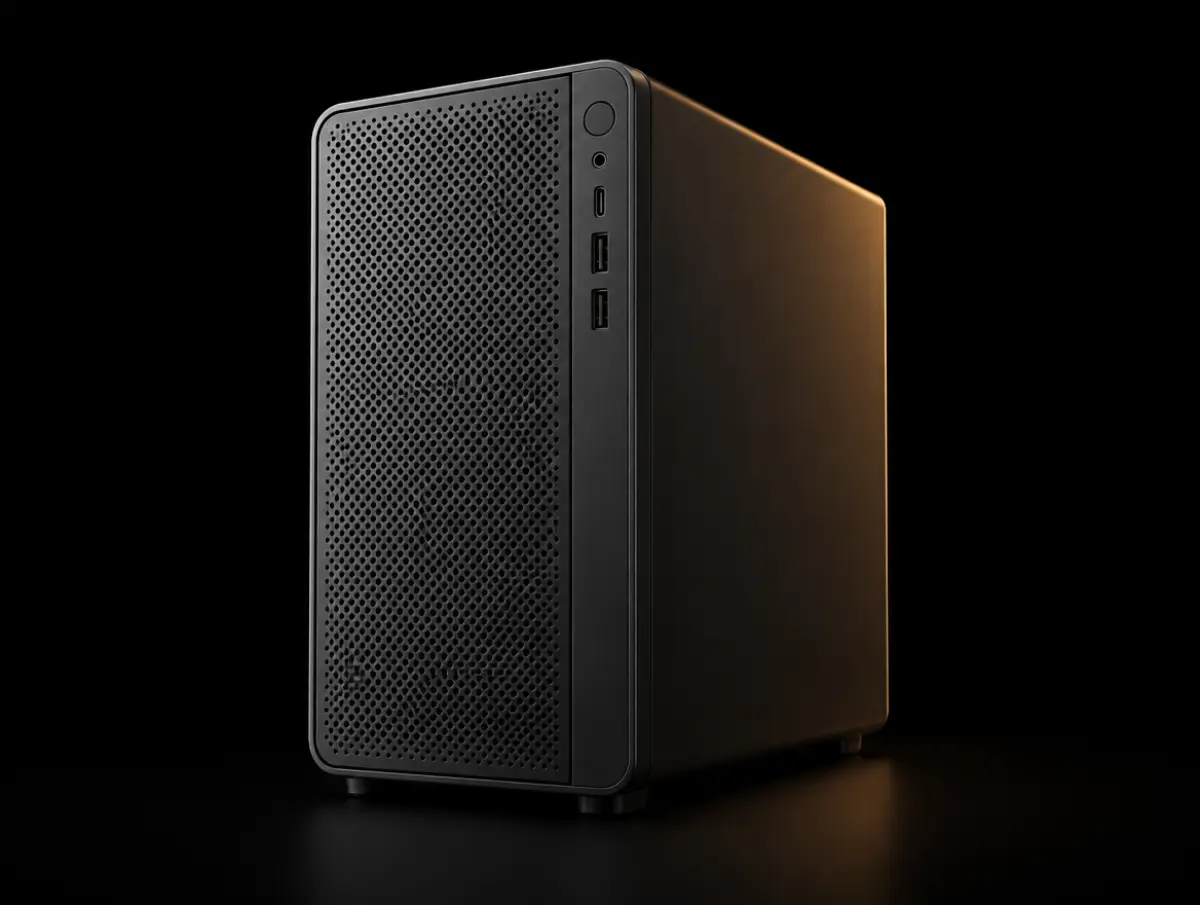
Not every AI workload needs a rack. Model development, prompt engineering, evaluation harnesses, fine-tuning small models and serving a team-internal assistant all run on hardware that plugs into a wall socket. The question is which class of desk machine matches the job: a unified-memory system like DGX Spark, a workstation with RTX PRO cards, or a GeForce build.
DGX Spark: 128 GB on the desk
DGX Spark is built around the GB10 Grace Blackwell superchip: a 20-core Arm CPU and a Blackwell GPU sharing 128 GB of LPDDR5x unified memory at ~273 GB/s, in a chassis the size of a small book that draws under 250 W. NVIDIA quotes up to 1 PFLOP of FP4 (sparse) tensor performance. It ships with DGX OS, the NVIDIA AI software stack preinstalled, and a ConnectX-7 port that lets two units be paired over 200G for models that need ~256 GB.
The important number is the memory, not the FLOPS. 128 GB means a 70B model at FP8, or a 120B-200B model at FP4, loads on a device that costs a fraction of a data center GPU. The important limitation is bandwidth: 273 GB/s is roughly one sixth of an RTX 5090 and one seventeenth of an H200. Decode speed for large models is in the single-digit to low-double-digit tokens per second range. That is fine for development, evaluation and low-concurrency internal use, and wrong for serving.
- Good for: running large models locally to test prompts, quantization and agent pipelines; fine-tuning with LoRA up to ~70B; the same software environment (CUDA, NIM, containers) as DGX servers.
- Not for: multi-user serving, latency-sensitive applications, x86-only software (the CPU is Arm), or any workload where tokens per second is the metric.
RTX PRO Blackwell workstations
The RTX PRO 6000 Blackwell Workstation Edition carries the same 96 GB GDDR7 and ~1.6 TB/s as its server sibling, actively cooled, 600 W, with display outputs; the Max-Q variant runs at 300 W for quieter and denser builds. Below it, RTX PRO 5000 (48 GB, with a 72 GB variant announced), RTX PRO 4500 (32 GB) and RTX PRO 4000 (24 GB) cover smaller models. All are ECC-capable, support the professional driver branch and, on the PRO 6000, MIG.
A dual RTX PRO 6000 workstation gives 192 GB of fast VRAM in a tower that runs from a standard 16 A circuit. It runs a 70B model at FP8 at interactive speed for a small team, fine-tunes 30B-class models in full precision with LoRA, and doubles as a rendering or simulation machine. This is the desk machine for teams that will graduate to a server and want to develop on the same architecture.
GeForce RTX 5090 and 5080
RTX 5090 ships 32 GB GDDR7 at ~1.8 TB/s and 575 W; RTX 5080 has 16 GB at ~960 GB/s and 360 W. Both have Blackwell tensor cores with FP4. The 5090 is the fastest single card for small models by bandwidth and a common choice for individual developers, diffusion workloads and local coding assistants running 20B-32B models at FP8 or ~70B at 4-bit with offload.
Limits to state plainly: GeForce cards have no ECC on the memory, the consumer driver EULA prohibits data center deployment, they are 3-3.5 slots wide with axial coolers that cannot be racked in numbers, and the 5090 can trip a 650 W power budget at spikes. They are excellent development cards and the wrong thing to build a hosting product on.
Side by side
| DGX Spark | RTX PRO 6000 WS (×1) | RTX 5090 | RTX 5080 | |
|---|---|---|---|---|
| Memory | 128 GB unified LPDDR5x | 96 GB GDDR7 ECC | 32 GB GDDR7 | 16 GB GDDR7 |
| Bandwidth | ~273 GB/s | ~1.6 TB/s | ~1.8 TB/s | ~960 GB/s |
| Power | <250 W system | 600 W (300 W Max-Q) | 575 W | 360 W |
| Largest comfortable model | 70B FP8 / 200B FP4 | 70B FP8 / 120B FP4 | 32B FP8 / 70B 4-bit | 14B FP8 / 32B 4-bit |
| Multi-user serving | No | Small team | One user | One user |
| Fine-tuning | LoRA to ~70B (slow) | LoRA to ~70B, full to ~13B | LoRA to ~13B | LoRA to ~7B |
| Pro driver / ECC | Yes (DGX OS) | Yes | No | No |
What surrounds the GPU
- CPU and RAM: 64-128 GB DDR5 minimum on x86 workstations; offload, tokenization and data preparation are host-bound.
- Storage: 2-4 TB NVMe. Model checkpoints are large and you will keep several.
- Power and thermals: a 1000-1600 W PSU for dual-GPU towers; check that the room can dissipate 1 kW continuously.
- PCIe lanes: Threadripper PRO or Xeon W boards give each card x16; consumer boards split lanes across two cards.
Nodeforge supplies DGX Spark, RTX PRO Blackwell workstation cards and complete workstations from Dubai and Hong Kong stock, and GeForce RTX 50-series cards for development builds. Tell us the models and the team size, and we will recommend a configuration that leaves headroom for the next model release.
Next step
Need help choosing the hardware?
Send the model and the workload. An engineer replies with a BOM, availability in Dubai and Hong Kong, and lead times.
Related
Keep reading
Choosing GPUs for LLM inference vs training
Inference is a memory problem, training is a bandwidth-and-interconnect problem. How to size VRAM, read precision figures and decide between PCIe cards and NVLink systems.
How to read a GPU spec sheet
Memory, bandwidth, TFLOPS by precision, TDP, form factor, PCIe generation, MIG, NVLink, licences and warranty. A field guide to the numbers on a data center GPU datasheet and the ones that are missing.
H200 NVL vs RTX PRO 6000 vs L40S: where each wins
Three PCIe cards, three price bands. A side-by-side of memory, bandwidth, power and cooling, and the workloads where each is the right answer rather than the expensive one.